
by Brandon Agosto
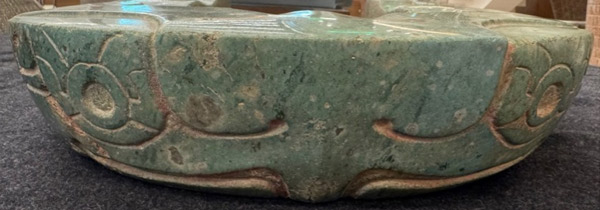
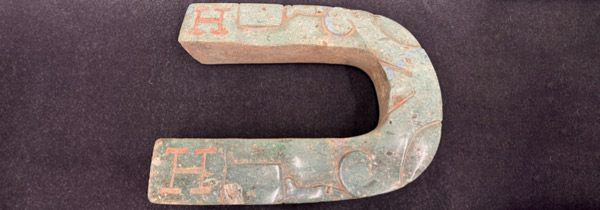
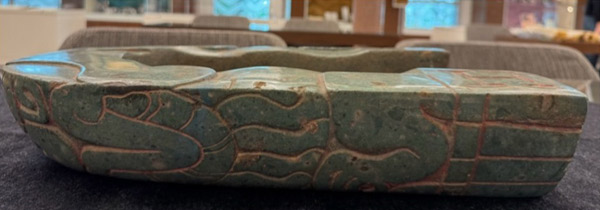
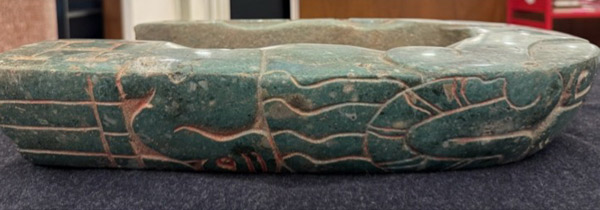
Ceremonial Ballgame Yoke with Reptilian Earth Monster, Mexico, Veracruz, Middle Classic AD 400-700, Carved green diopside or porphyry, with red cinnabar 1987.034.00.0002
This greenstone sculpture, known as a “Yoke” or U-shaped implement, is representative of a type of protective equipment worn on the waist by players during a sport known as the Mesoamerican ballgame. These sculptures made of heavy stone, however, are likely ceremonial examples of variants made of perishable materials used during the agile sport. The center of the sculpture depicts a frontal-facing amphibian—with rounded pupils, broad nostrils, and wide mouth with exposed tongue. The figure’s limbs are noticeably bent, suggestive of depictions of a tree frog or toad emerging from the composition.
Intricate carvings of linear and interlocking designs are diagnostic of yokes from the Mexican region of Coastal Veracruz. Several stylized scrolls are incised in low relief to accentuate the retractable nature of the figure’s eyes. The sides of the frog sculpture are rendered with wave motifs that represent the ripples of water and features of an earth divinity, demonstrating its journey from the underworld. In Mesoamerican mythology, frogs were considered liminal figures within the underworld and terrestrial realms, serving as messengers associated with new life and the rebirth of figures. The yoke’s relief imagery has been decorated with a red pigment either of precious cinnabar or hematite, natural minerals applied to funerary burials and ritual objects associated with vitality and blood. It is possible this sculptural implement was part of an elaborate burial offering protection to its owner after death.
The top of this sculpture is also incised with intricate scrollwork and two “capital H” motifs that are suggestive of the planar view of Mesoamerican ballcourts and their perpendicular endzones. The Mesoamerican ballgame was an important activity forging communal, social, and ritual events throughout the region. The sport was played using a solid ball made of rubber, a plant polymer used throughout the Americas, from the Southwestern United States to the Gran Chaco Forest of Argentina. (Filloy Nadal 2001: 21, Stern 1966: 4–5). Ballcourts in North-Central Veracruz were constructed with endzones forming an “I” shaped playing field. Although the rules of the game varied, Spanish chroniclers from the sixteenth century documented Mexica (Aztec) players using their upper arms and thighs to strike the ball. The stakes of the game could be dire, resulting in a vigorous play of life or death corresponding to the movements of divinities and celestial bodies. This expertly carved monument likely serves as a commemoration of the fast-paced sport, the symbolic fecundity of frogs, and an activation of bodily renewal as its owner journeyed into the afterlife.
How this object relates to my research: Several stone yokes have been excavated at El Tajín, Veracruz, including some with amphibian imagery from the Building 11 ballcourt. The site’s archaeological context will allow me to compare imagery with works such as this one and their relationship to mural painting and other ritual implements discovered at Building 11.
Further reading:
- Filloy Nadal, Laura. “Rubber and Rubber Balls in Mesoamerica,” In: The Sport of life and Death: The Mesoamerican Ballgame, pp. 20–31, edited by E. Michael Whittington, Thames & Hudson, 2001.
- Leyenaar, Ted J. J. Ulama: The Perpetuation in Mexico of the pre-Spanish ball game Ullamaliztli. E. J. Brill, 1978.
- Miller, Mary E. “The Ballgame,” Record of the Art Museum Princeton University, Vol. 48, no. 2, (1989): 22–31.
- Scarborough, Vincent L., and David R. Wilcox (Eds.). The Mesoamerican Ballgame. University of Arizona Press, 1991.
- Shook, Edwin M., and Elayne Marquis. Secrets in Stone: Yokes, Hachas, and Palmas from Southern Mesoamerica. American Philosophical Society, 1996.
- Stern, Theodore. The Rubber-Ball Games of the Americas. Monographs of the American Ethnological Society, 17, University of Washington Press, 1966.
- Uriarte, María Teresa. “Unity in Duality: The Practice and Symbols of the Mesoamerican Ballgame,” In: The Sport of life and Death: The Mesoamerican Ballgame, pp. 40–49, edited by E. Michael Whittington, Thames & Hudson, 2001.
 A Librarian