
Jay I. Kislak Fellowship Object Highlight
by Claire Lavarreda
Where would you look to find a star? You might say the sky, but at the University of Miami, there’s a specific journey to take. First, you will need to enter the Kislak Center, where you’ll be met by Kislak Collection Manager Arthur Dunkleman or Kislak Chair Daniel Arbino. You’ll then be led up the stairs and into the gallery, where a variety of exhibits and items will greet you — including a Mayan wall fragment (600-750 CE), a parfleche bag (1850 CE), and a Baldwin-Ziegler polar expedition buoy (1902 CE). (See image 1). Among these precious items, a hidden “star” is kept in the Kislak vault — a seventeenth-century text bound in puckered vellum, titled La Estrella De El Norte De México.
During my time as a short-term Kislak research fellow in September 2025, La Estrella De El Norte De Mexico (1688) captured my attention due to its connection to my research topic, Indigenous contribution to Catholic text production in New Spain. The book was written by Francisco de Florencia (1620-1695), a Jesuit priest born in Saint Augustine, Florida, who was one of the early proponents of Marian devotion in the New World.1 In addition to being the first Floridian author, Florencia was the fourth historian in the Compañía de Jesús in the Americas, most notable for elaborate works like the Historia de la Provincia de la Compañía de Jesús de Nueva España (1694) and the Zodíaco Mariano (1755).2 La Estrella De El Norte De Mexico was printed in 1688 by Doña María de Benavides, daughter of printer Alcalaíno Bernardo Calderón. Despite her family’s legacy in print and her own role as a prolific printer, Doña María de Benavides frequently identified herself as the “widow of Juan de Rivera,” who himself was a printer.3
As the product of the first Florida-born writer and a female printer, La Estrella De El Norte De Mexico is already quite rare — but its subject matter and physical appearance make it invaluable. The story is that of the miraculous apparition of the Virgin Mary as witnessed by Saint Juan Diego Cuauhtlatoatzin (1474-1548), who was an Indigenous Chichimecan. According to authors like Florencia and Antonio Valeriano (who wrote El Nican Mopohua, a Nahuatl text on the event predating Florencia’s by 132 years), Juan Diego Cuauhtlatoatzin was visited twice by Mary. Upon the second visit and his request for evidence of her appearance, Juan Diego Cuauhtlatoatzin’s tilma — previously filled only with roses — was miraculously imprinted with her image.4 This apparition was deemed “Nuestra Señora de Guadalupe,” and has since retained cultural devotion as the “Patroness of the Americas,” with Diego’s cloak on display at the Insigne y Nacional Basílica de Santa María de Guadalupe in Mexico City. The text is accompanied by a unique frontispiece, bearing an early image of Nuestra Señora in her robe covered in stars.5 (See image 2).
The particular copy held at the University of Miami has one more unique feature – a marca de fuego. Branding books with a hot iron was a common practice in New Spain, especially in Mexico. According to the project “Catálogo Colectivo de Marcas de Fuego,” Catholic libraries, seminaries, and colleges would brand books in their collections with an identifier along the fore edge to indicate ownership.6 These brands would feature the initials or the defining symbol of the institution – for example, the Kislak copy bears the mark of the Seminario Conciliar in Mexico City, specifically, the Collegio Seminario de la Santa Iglesia Cathedral de Mexico. (See image 3). It features a monogram with intertwining letters that are meant to “unfold” into the word Seminario.7 Though there are a few cases of marcas de fuego across Europe, the general consensus is that these brands were a distinctly New Spain phenomenon, created and controlled by Catholic institutions.8 Several of these institutions included Indigenous clergy, such as the Real y Pontificio Colegio Seminario Conciliar o Tridentino.9 Though further research would be required for definitive evidence, it is highly possible that the Collegio Seminario de la Santa Iglesia Cathedral de Mexico had Indigenous students given the Catholic focus on conversion, translation, and education.10
La Estrella De El Norte De Mexico (1688) by Francisco Florencia is a wonderfully unique item, serving as an example of the cultural mestizaje that occurred between the Spanish and Indigenous peoples of New Spain. As one of the many items in the Jay I. Kislak collection that confronts the complexities of cultural encounters in the early Americas, this book is particularly valuable for my research on Catholic text production in the New World. Specifically, La Estrella De El Norte De Mexico is a strong illustration of the way in which texts contributed to the cross-fertilization of religious belief systems between Indigenous peoples and European Catholics.
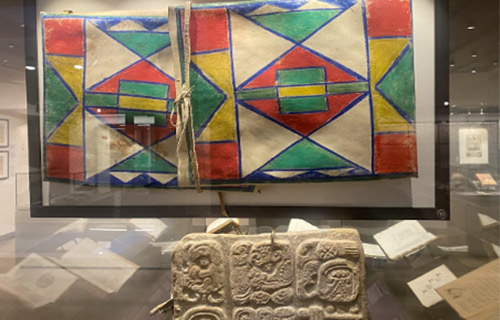
(1). A photo of a Plains Indian Parfleche bag dated to 1850 CE, located in the Kislak gallery. Beneath it is the top part of a fragmented Mayan wall panel, dating to 600-750 CE.
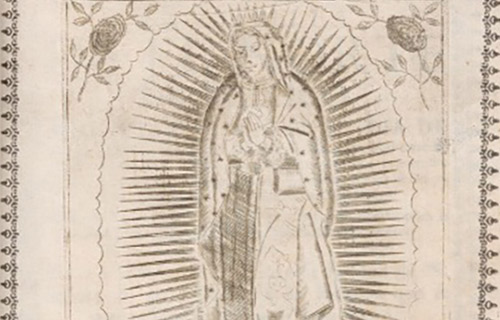
(2). A photo of the frontispiece engraving in La Estrella De El Norte De Mexico. Nuestra Señora De Guadalupe is standing on a crescent moon, wearing her iconic starry robe.
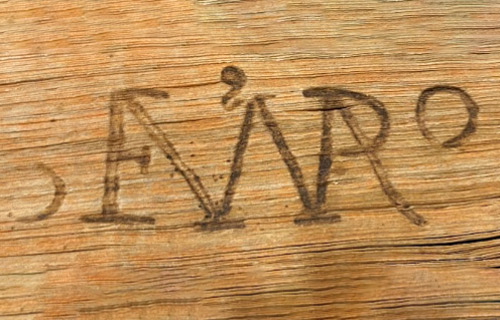
(3). A photo of the marca de fuego. The letters are intertwined, but when “unfolded,” spell SEMINARIO. The “S” at the beginning is cut off at the top.
- 1 Jason Dyck, “Bastions of the Virgin: Francisco de Florencia’s Marian cartography of Mexico City,” Colonial Latin American Review, 28 no. 3 (2019), pp. 336–366. doi: 10.1080/10609164.2019.1655886
- 2 Ibid., 339. Dyck notes that the exact date of the original Zodíaco Mariano is unknown – possibly dating to the 1690s — and that Juan Antonio de Oviedo edited and compiled Florencia’s work for publication in 1755. See also Ernesto de la Torre, “Francisco Florencia S.J.” in Lecturas Históricas Mexicanas (Universidad de Mexico, 2015), 574-579.
- 3 Though not directly stated, I believe Benavides likely identified as Rivera’s widow due to colonial gender expectations and for printer/shop consistency. Sue Luftschein, “‘A Woman of Great Courage’: Women in the Printing Trades in Early Modern Europe: María de Benavides,” USC Libraries, March 3, 2023, https://scalar.usc.edu/works/a-woman-of-great-courage-women-in-the-printing-trades-in-early-modern-europe/maria-de-benavides-active-c-1684-1700
- 4 The Vatican, “Juan Diego Cuauhtlatoatzin,” The Holy See, accessed November 13, https://www.vatican.va/news_services/liturgy/saints/ns_lit_doc_20020731_juan-diego_en.html
- 5 I am particularly interested in this image, and plan on researching it for potential Nahua contribution in its creation in my forthcoming dissertation.
- 6 El Catálogo Colectivo de Marcas de Fuego, “Proyecto: Descripción,” Catálogo Colectivo de Marcas de Fuego, accessed August 21, 2024, https://tinyurl.com/jnzf4pj4
- 7 Catálogo Colectivo de Marcas de Fuego, search catalogue for mark identifier BEFK-9020.
- 8 Ibid, “Proyecto: Descripción.” Note that marking books was a practice across Europe – however, the specific marcas de fuego were unique. See Jessica Leigh Hester, “Why Medieval Monasteries Branded Their Books,” Atlas Obscura, June 22, 2018, https://www.atlasobscura.com/articles/why-did-missionaries-brand-books
- 9 Catálogo Colectivo de Marcas de Fuego, search catalogue for mark identifier BJML-9009.02
- 10 For a detailed work on the religious syncretism that occurred between Mesoamerican religions and Catholicism, see Mark Z. Christensen, Nahua and Maya Catholicisms: Texts and Religion in Colonial Central Mexico and Yucatan, (Stanford University Press 2013).
 A Librarian