
by Misael de la Rosa
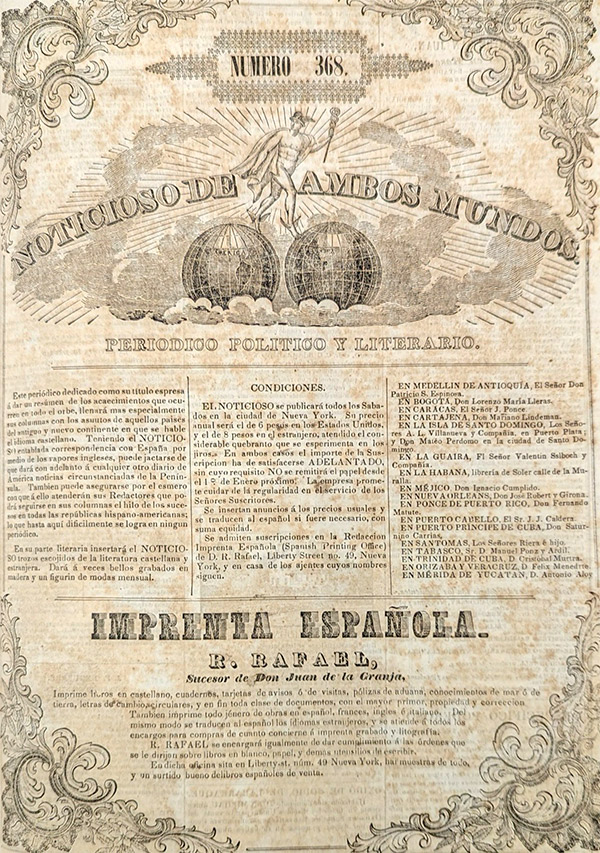
Not much attention has been placed into the study of El Noticioso de Ambos Mundos (1835-1845). Founded by Juan de la Granja, the publication would see a change in editorship in July of 1841. It was at this time that a new group of young Spaniards, including Pedro Aguilar, would take over the reigns. While the subtitle of the periodical would shift in tandem with the change in editorship, its mission would remain the same. That is, to disseminate news and cultural production from the Spanish-speaking world on both sides of the Atlantic.
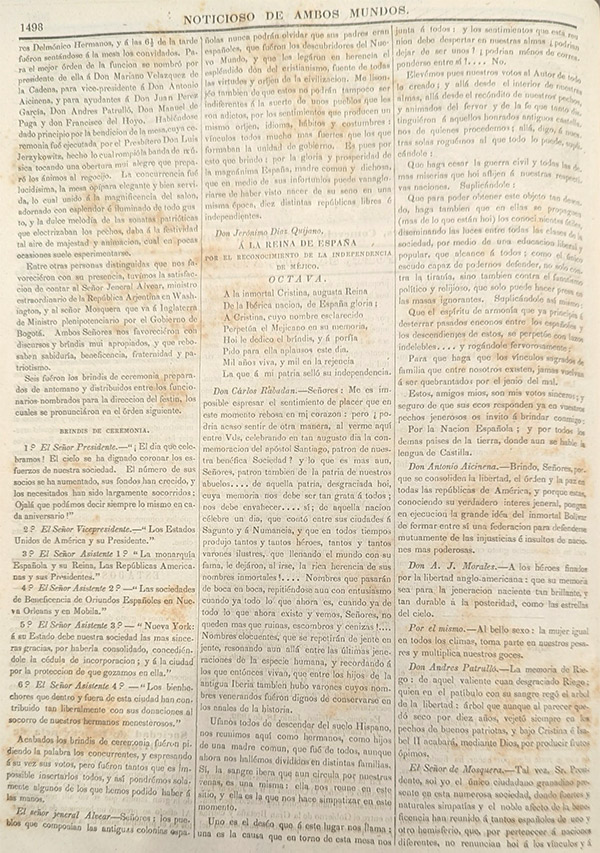
While the paper clearly held a pro-Spanish sentiment as seen in the amount of space dedicated to news and cultural production from Spain, through its ten years of life, the paper attempted to create an early sense of kinship akin to Latinidad. This becomes evident in issue 188 with the transcription of speeches given on July 25th, 1839 during the celebration of El Patron Santiago. Some of the excerpts follow:
“Brindo, señores, porque se consoliden la libertad, el orden y la paz en todas la republicas de América, y porque estas, conociendo su verdadero interés jeneral, pongan en ejecución la grande idea del inmortal Bolívar de formar entre si una federación para defenderse mutuamente de las injusticias e insultos de naciones más poderosas”1 (Antonio Aicinena)
“Ufanos todos de descender del suelo Hispano, nos reunimos aquí como hermanos, como hijos de una madre común, que fue de todos, aunque ahora nos hallemos divididos en distintas familias”2 (Carlos Rabadan)
“Y que prosperando a la par con ella las nuevas republicas hispano-americanas, se propague la civilización y la fortuna donde quiera que se hable la lengua española,”3 (señor de Mosquera)
The toasts made by these attendees serve as evidence of the desire for Spanish speakers in New York to consolidate a sense of identity beyond the nation. In this case, that identity was tied to a shared history and the Spanish language. And, while a focus on Hispanic heritage and the Castilian language was inherently exclusionary of indigeneity and blackness, the paper’s distinction between ‘hispano-americanos’ and ‘anglo-americanos’ points toward a burgeoning sense of Latinidad in the nineteenth century.
A thorough discussion of El Noticioso de Ambos Mundos would require much more time than is allowed in this space. It is an exciting text that captures a snapshot of Latinx life in the United States at a moment when nation-based identities in the Americas were still in their embryonic stages. If nothing else, El Noticioso calls on Latinx Studies scholars to step into the archives and listen to those voices that have for so long been silenced.
- 1 I toast, gentlemen, for the consolidation of liberty, order, and peace in all republics of America, and for these, knowing their true general interest, to execute Bolivar’s immortal idea of forming amongst themselves one federation to defend one another against the insults and injustices from more powerful nations. (my translation)
- 2 Smug to be descended from Hispanic soil, we are gathered here like brothers, like sons of a shared mother, that was all of ours, despite finding ourselves divided amongst different families. (ibid)
- 3 And that prospering hand-in-hand [Spain] with the new Hispanic-American republics, civilization and fortune spreads everywhere that the Spanish tongue is spoken. (ibid)
 A Librarian