
by Daniel Arbino
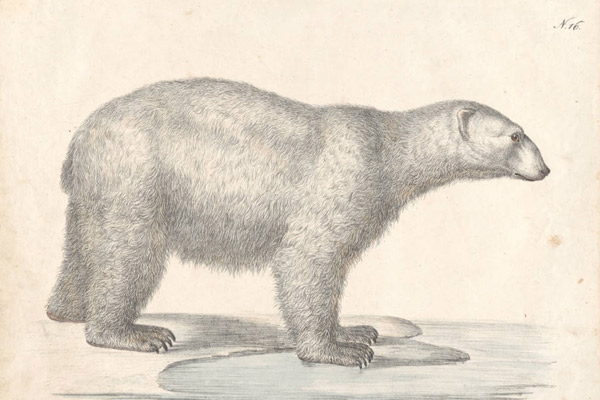
I have been the Chair and Curator of the Jay I. Kislak Collection of the Early Americas, Exploration and Navigation for two years, and in that time, I have made a dent into understanding the richness of a collection that spans an entire hemisphere. As a Caribbeanist first and foremost, there are many intriguing materials from the region that form a part of the Kislak Collection. Handwritten correspondence, like those from Dominican governor John Orde, and books like a Short History of Barbados (1768) provide great insight into the colonial period of the region. However, there is one item in the collection that continues to stand out to me: Karl Joseph Brodtmann’s 1816 hand-colored lithograph, Der Eisbar.
My reasoning for this is inexplicable. My background is in twentieth- and twenty-first-century Caribbean literature, far from the frozen arctic region of this nineteenth-century image. Yet there is something that haunts me about the 13 by 16-inch piece of art. Could it be that I have never studied polar expeditions and thus they speak to me as something unique? That would be an easy explanation, but it is deeper than that.
It starts with the coloring. Set against an off-white backdrop, the polar bear takes on a darkish gray hue that evokes an unfamiliarity when compared to the powder-white images that we can view on Google. This gray tone is strongest around the bear’s underbelly and paws. Something is amiss.
The blue of the water is almost indistinguishable from the ice. Almost, but not quite. It is not the blue that we know in Miami, that undulates between cerulean, turquoise, and aquamarine. In Brodtmann’s work, the water is frigid and dull. With the air conditioning blasting through the gallery in July, a person might shiver while examining it.
What is the purpose of this piece? Classifying the animal kingdom was tied to colonialism and later, imperialism. European powers expressed a need to categorize everything, even, sadly, people. To wit, Brodtmann has several similar works showcasing Indigenous and Black people in the colonies. While doing so enhanced scientific knowledge, taxonomies created hierarchies of power that were often wielded in attempts to dominate nature or other civilizations.
When I look at this image now, I am left with a cold melancholy. There are approximately 22,000 polar bears still in the wild, a number that has stabilized over recent years. However, despite seemingly being a world away, their fate is linked closely to that of a south Floridian. If sea ice continues to melt, their population will dwindle quickly over the next three decades as they will be less mobile to hunt or mate. As ice melts to water, Floridians will face the threat of rising ocean levels that will alter our way of life.
More than just a majestic image, this lithograph recalls the colonial and imperial imposition of order on others and serves as a reminder of our responsibility to animals through acts of conservation. Der Eisbar is currently on exhibition in the Kislak gallery.
 A Librarian