
Serialized Fiction in Cuba Before the Revolution
Fall 2025 – Summer 2027
Roberto C. Goizueta Pavilion, Otto G. Richter Library, Floor 2
In the mid-20th century, Cuba was a leading force in the introduction of radio and television in Latin America. “El derecho de nacer” [“The Right to Be Born”], written by Félix B. Caignet and broadcast by CMQ from 1948 to 1949, was an unprecedented audience success and was later adapted in Mexico, Venezuela, Brazil, and other countries in the region.
From then on, Cuban radio plays circulated in a myriad of ways: They were adapted into films and, following the arrival of television, remade as serials—first weekly, then daily. Shows such as “Miércoles de Amor Palmolive” [“Wednesdays of Palmolive Love”] and “Un romance cada jueves” [“A Romance Every Thursday”] were broadcast live, featuring stars with enormous popular appeal. They established long-lasting conventions in themes, styles, and formats, defining production standards for decades to come.
Following the revolution in 1959 and the subsequent nationalization of the media sector, audiovisual production in Cuba became an essential part of the new political project. Some writers, producers, actors, and technicians remained on the island, while others were forced to emigrate. In both cases, this led to a consequential movement of ideas, knowledge, and narratives.
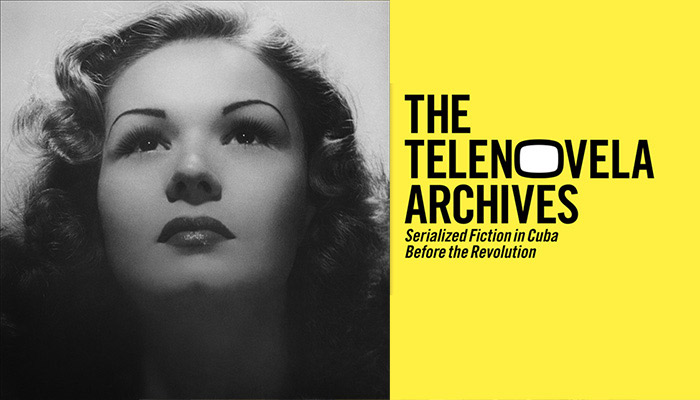
Curated from the extensive holdings of the Cuban Heritage Collection and the Telenovela Archives, “The Telenovela Archives: Serialized Fiction in Cuba Before the Revolution” uses visual evidence from the time period—including photographs, advertising materials, books, periodicals, films, videos, and more—to explore and preserve the history of the telenovela and other serialized drama formats in Cuba and Latin America. The installation serves as a tribute to Cuban creators and an opportunity to understand their cultural impact across the continent and for generations to come.
This exhibition is presented in partnership with the Canada Council for the Arts, the London Arts Council, the Faculty of Arts and Humanities at the University of Western Ontario, Triana Media, and Cinemateca Brasileira.
Read the News@TheU story about the exhibition.
A mediados del siglo XX, Cuba desempeñó un papel protagónico en la introducción de la radio y la televisión en América Latina, ejerciendo gran influencia con respecto a contenidos y modos de producción.
‘El derecho de nacer’, una radionovela escrita por Félix B. Caignet y producida por CMQ (1948—49), fue un fenómeno de audiencia sin precedentes, luego replicado en México, Venezuela, Brasil y otros países de la región. Su popularidad aceleró un fértil proceso de circulación de historias, con la ficción en serie como una eficiente estrategia de programación radial.
La llegada de la televisión (1950) señaló el comienzo de una nueva etapa.Los primeros programas eran en vivo, primordialmente teleteatros, pero luego se exploraron mecanismos para producir historias con continuidad o seriadas: novelas para televisión. Tal como ocurre hoy en la industria de los medios, el objetivo era la creación de hábitos: convencer a las audiencias de que vieran un episodio tras otro.
Hacia finales de la década del 50, la novela televisada ya había adquirido sus rasgos más distintivos en varios países del continente, incluida Cuba. Se trata de seriales de duración limitada –historias con un desenlace- y transmitidas en horario estelar.
‘The Telenovela Archives’ es una iniciativa de investigación, documentación y divulgación. Desarrollada por Triana Media, está dedicada a explorar y preservar la historia de la telenovela y otros formatos de ficción dramática en América Latina.
El material incluido en esta exhibición se enfoca en los orígenes de lo que se convirtió en un fenómeno global. Curada a partir de los amplios fondos de la Cuban Heritage Collection, The Telenovela Archives: Series de ficción en Cuba antes de la Revolución presenta evidencia visual del trabajo producido en ese período: fotografías, materiales publicitarios, libros, publicaciones periódicas, películas y vídeos. Es un acercamiento a las a las historias que se crearon en Cuba, y una oportunidad de entender su impacto, a lo largo del continente y a través de generaciones.
Lee la historia de esta exhibición en News@TheU.
 A Librarian